




Ten years and counting is too long to wait for accessible health information
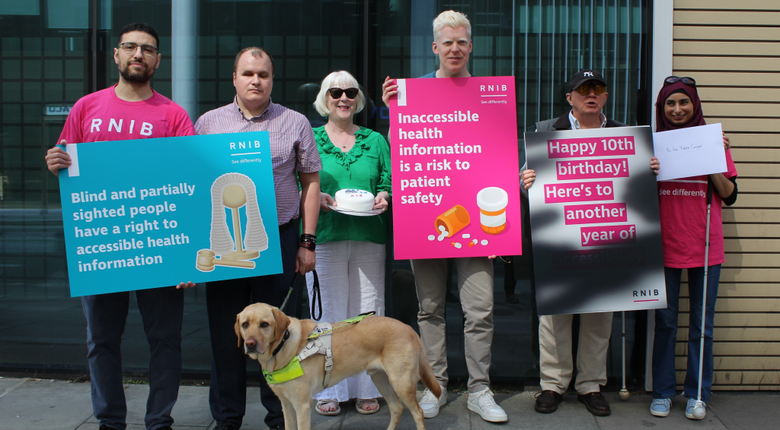
RNIB supporters stand outside the Department of Health and Social Care to mark the tenth birthday of the NHS Accessible Information Standard.
A decade after the launch of the NHS England Accessible Information Standard, RNIB campaigners went to the Department of Health and Social Care (DHSC) to celebrate its tenth birthday.
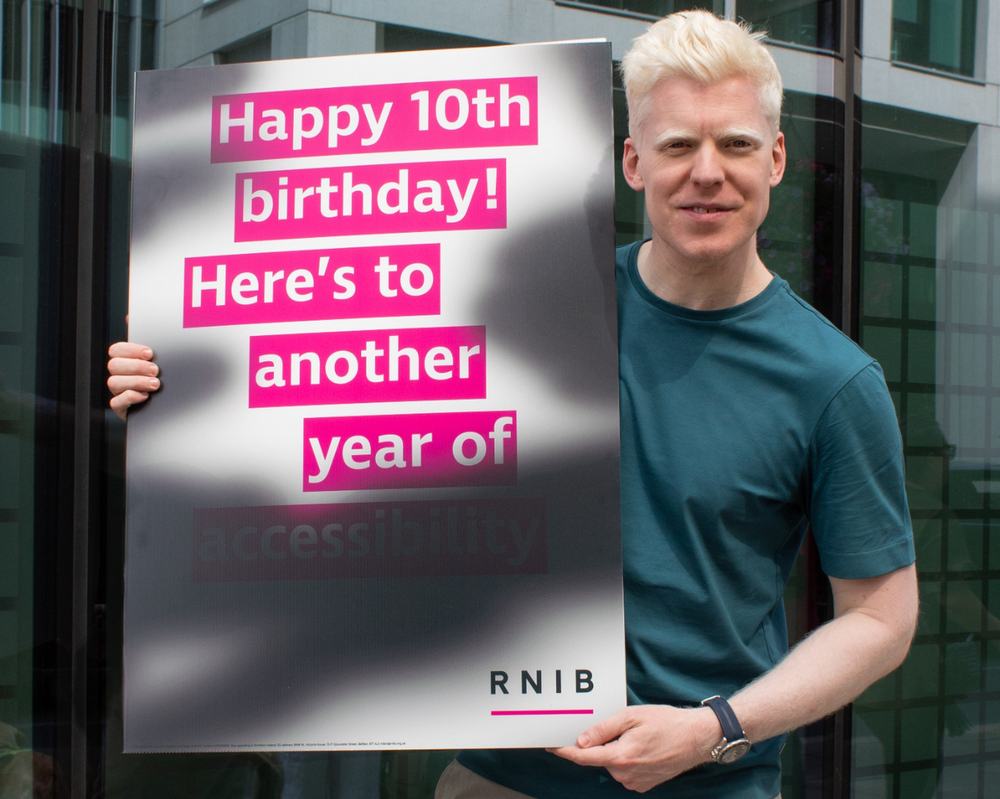
We were joined by doctor and broadcaster Dr Oscar Duke, to call for the NHS Standard to be made mandatory across the health and care system. Too many blind and partially sighted people continue to receive important health and care information – like appointment letters or healthcare leaflets – that they are unable to read. This puts their health and safety at risk.
To mark the tenth birthday of the NHS Standard, Dr Oscar joined RNIB Chair Anna Tylor and RNIB campaigners outside the DHSC with a birthday cake and birthday card addressed to the new Health Secretary, Yvette Cooper.
Khadija Raza, RNIB Policy Lead for accessible health information, said:
“We want to celebrate the NHS Standard for existing, but we have an important birthday wish. Blind and partially sighted people shouldn’t have to wait any longer for accessible health and care information to be put into practice. It’s time for the Health Secretary to make the NHS Standard mandatory, and ensure it is fully implemented throughout the NHS in England.
As the new Health Secretary continues the government’s reforms to the NHS in England, and steps up the digitalisation of its services, it’s critical that she understands just how important this issue continues to be for the UK’s 320,000 blind and partially sighted people.”
Speaking up for accessible health information
As a GP, Dr Oscar Duke explained the frustration, loss of independence, and real safety risks experienced by patients due to a lack of accessible health information.
RNIB Chair Anna Tylor spoke powerfully about her own experience of inaccessible health information, after being misdiagnosed as terminally ill in 2024. She said:
“In that moment, when the world was collapsing around me, the Oncology Team offered the support of a palliative care nurse. As she handed me her details on a card, she said: I know you can’t read this, but this is how you reach me.”
What is the NHS England Accessible Information Standard?
The NHS Standard makes clear how NHS and publicly funded adult social care services in England need to meet the information and communication needs of patients, including blind and partially sighted people. This means being able to receive health and care information in alternative formats like large print, email, audio, and braille.
Unfortunately, many blind and partially sighted people continue to receive important health and care information they are unable to read. This puts their health and safety at risk and can seriously affect independence, privacy, and dignity.
Inaccessible health information is all too common
In 2022, a campaign report by RNIB and partner charities highlighted that 77 per cent of people with accessible information needs reported rarely or never receiving information in alternative formats. While an update to the Standard in 2025 made some improvements, we know that the health system is still struggling to make accessible health information a reality in practice.
Rachael Andrews from Norfolk needs to receive her health information by plain text email, but she recently received a printed letter about her medical condition. Rachael has a personal assistant who helps her with reading some of her post, but understandably Rachael doesn’t want to have to share her personal medical information and would feel deeply uncomfortable about doing so.
In the past, Rachael was discharged from a clinic and then had to re-register, because letters about appointments were sent to her in standard print leaving her unaware of them. She said:
“Ninety-nine percent of the time you are going to an appointment because you are in pain, you are not well or you are concerned, and the fact that you have to chase [for accessible information] all the time, it’s extra admin that you have to take on when you are not feeling well.”
Sam Fox from Essex has a number of complex health needs. Sam says that sending her a letter about her health is, in effect, the same as sending her a blank piece of paper, because it’s of no use.
Sam requests all her medical information in an email so that she can use text to speech software to have her information read to her. She has had positive as well as negative experiences with her information needs being supported. She said:
“When you are ill, you don’t want to have to stand up and fight to get the information that you can read. When it does happen, it’s great but when it doesn’t, you feel frustrated, upset and angry and this has been going on for 10 years.”
RNIB’s call for change
The newly appointed Health Secretary, Yvette Cooper, must ensure the NHS Accessible Information Standard is made mandatory, and that accessible health and care information is put into practice across all NHS and publicly funded adult social care services.
This means that the DHSC must prioritise accessible health information as part of its reforms to the NHS, especially as it moves towards single patient records and increased digitalisation.
Take action
Find out more about the My Info My Way campaign, including:
- How you can request health and care information in your required format if you're blind or partially sighted.
- How to call for accessible health and care information to be provided in your local area.