




Shop RNIB Donate now

Accessible streets

We should all be able to leave home and travel safely to work, visit the doctor, go shopping, meet friends and enjoy being outside without having to dodge street hazards or being forced into the road.

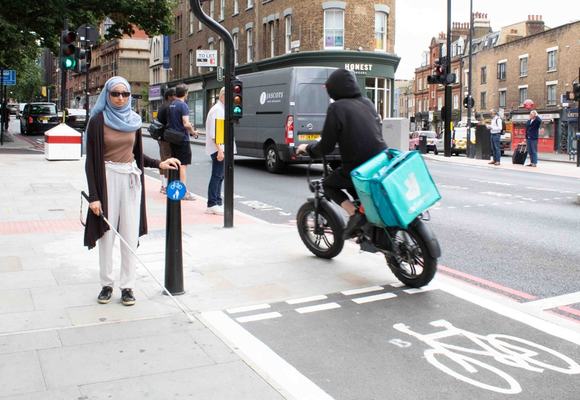
Every day, blind and partially sighted people encounter inaccessible pedestrian crossings, trip hazards caused by damaged pavements, abandoned hire bikes and e-scooters, and bins left out after collection days.

Get involved

Small actions make a big difference

A clearer street often starts with one small change. Simple actions at the right moment can help more people move around with confidence, from bringing bins in after collection and cutting back overhanging hedges to parking considerately and reporting hazards when you spot them.

Evidence for change

RNIB’s In My Way report found that:

  • 61 per cent of blind and partially sighted people say that they are not able to make all of the journeys they want or need to,
  • Only 9 per cent strongly agree that they feel safe making independent walking journeys in their neighbourhood.

Read our report to learn more about the practical steps that the UK Government, devolved administrations and local authorities should take to tackle hazards like pavement parking, overhanging greenery to making cycleways safer so that getting around on foot is more accessible and inclusive.

Improving street design

We've created a guide on inclusive street design that you could share with your Local Authority. These Key Principles will help ensure our streets are as accessible as possible. Inclusive design is better design for everyone: people with sight loss, other disabled people, older people, carers with children, and ultimately for all who wish to use our streets.

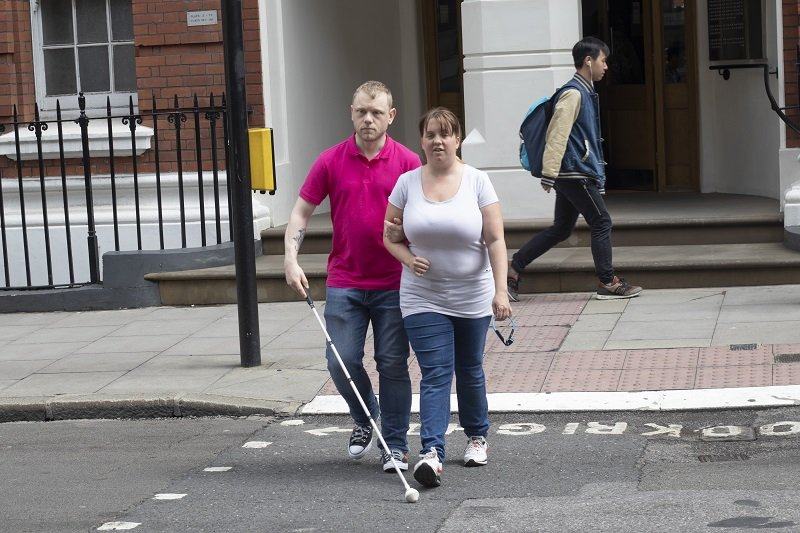
Hannah guiding Ray across the road

Hannah guiding Ray across the road

Frequently asked questions

Have a question about streets? We’ve answered the most asked questions about reporting issues, pavement parking, bus stops and more.

Street maintenance and reporting

Who is responsible for streets in my area? 

In general, responsibility for streets in your area typically falls to the local highway authority, typically a unitary authority or county council. They are responsible for maintaining and cleaning streets.

Local highway authorities are tasked with ensuring that public roads are safe and well-maintained. Their duties under the Highways Act 1980 include:

  • Regularly inspecting roads to identify defects such as potholes, debris, or damaged signs.
  • Taking timely action to repair hazards and maintain road safety.
  • Maintaining street lighting, traffic signs, and pavements.
  • Responding to reports of accidents or road hazards from the public.

To determine which authority is responsible for a particular road, check your local council website or use tools like FixMyStreet which allow you to enter a postcode or street name and area.

Who do I contact about a broken streetlight, traffic lights or pedestrian crossings? 

You can report a hazard or issue using FixMyStreet. If you live in London, you can also report issues via Streetcare. You can also contact your local council to find out more about reporting issues.

How and to whom should I report overhanging trees and bushes to? 

Report this to your local highways authority. They are responsible for maintaining vegetation on the public highway, in parks and on their own properties.

If the property is privately owned, the highways authority can ask property owners to cut back hedges or trees on their property if they’re causing an obstruction in the road. (If they refuse, the highways authority can go into the property to do the work themselves.)

Some councils have forms for such reports online. Please include:

  • The location of the problem.
  • The nature of the problem.
  • Any other relevant information.
  • Your contact details if you want to be updated on progress.
  • A photo if you have any.

Parking, vehicles and obstructions

What do I do if a car is parked on the pavement?

If the vehicle is parked:

  • on zig-zag lines
  • dangerously
  • in a way that would prevent emergency vehicles from accessing

You can report these to the police (by calling 101, going to the police station, or searching online for other ways to contact them).

If the vehicle is parked:

  • over a dropped kerb
  • on a pedestrian crossing (including the area marked by white zig-zag lines)
  • in spaces reserved for Blue Badge holders, residents or motorbikes (unless entitled to do so)
  • in marked taxi bays, cycle lanes or red lines
  • near a school entrance, bus or tram stop

Please report it to your local council.

Is pavement parking illegal?

In London and Scotland, drivers must not park on the pavement, the must indicating there is legislation behind this rule and they could receive a fine for breaking it.

In the rest of the UK, pavement parking is permitted unless specifically prohibited by a local authority through a Traffic Regulation Order (TRO), which would be indicated on nearby road signs.

Pedestrian crossings, bus stops, and road safety

When roadworks are being undertaken do they have to ensure there is a pedestrian access route?

Yes. UK Government guidance says utility companies and highway authorities (‘roads authorities’ in Scotland and Northern Ireland) must take into account the needs of children, older people and disabled people, having particular regard for visually impaired people.

Utility companies and highway authorities “must provide a suitable barrier that safely separates pedestrians from hazards and provides a safe route suitable for people using wheelchairs, mobility scooters, prams or pushchairs.”

What are floating bus stops, and is RNIB doing anything about them?

Schemes that require people to cross a cycle lane to access buses go by many names. They can be called 'floating bus stops' or bus stop islands (where there is an island that bus users need to cross a road to reach) or shared-use 'bus stop boarders' or 'bus stop by-passes' (where a cycle lane runs along the pavement and needs to be crossed before you can reach the bus stop).

Our position is that any bus stop at which a person needs to cross a cycle lane to board or alight from a bus is dangerous. All current designs disadvantage blind and partially sighted people. No new bus stops with cycle tracks should be deployed while that is still the case.

The Department for Transport is currently developing further national guidance on the safety and accessibility of bus stopping places which RNIB is feeding into. But this will take time, and we are deeply disappointed that bus stops with cycle lanes continue to be designed and installed, even though we know this excludes blind and partially sighted people from bus travel, their main form of transport. 

A crossing on my route doesn't make a noise, is this illegal?

There is no legal requirement for an audible signal. An audible signal is not appropriate at all pedestrian crossings.

If a crossing you use doesn’t “bleep,” check for a tactile signal – a plastic cone underneath the box with the button you press to get the green man. The tactile signal should be installed by default.

If no cone is there or if it’s not rotating during the “green man” phase where pedestrians are invited to cross the road, this can be reported to the local council as a fault which needs repairing.