





Two in five UK adults interested in listening to television drama without the screen, RNIB research finds
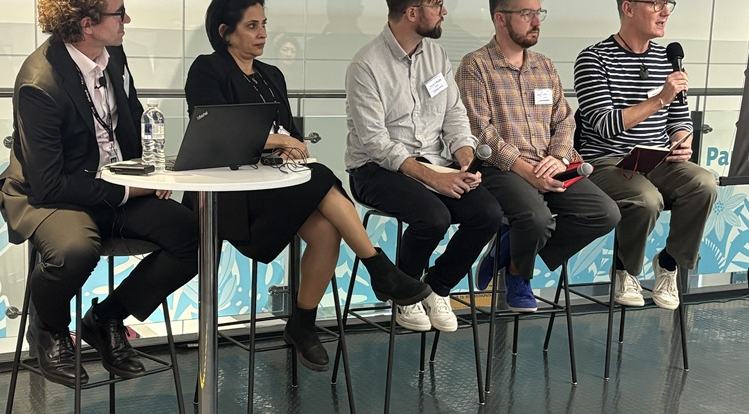
The panel discussion at the Audio Is King event held at RNIB's London headquarters, the Grimaldi Building.
New research commissioned by sight loss charity RNIB and conducted by Ipsos found that 42 per cent of UK adults aged 18 to 65 expressed interest in listening to television drama without the screen after hearing examples of the experience.
The research tested 'described drama': a television programme's original soundtrack - including dialogue, music and sound effects - mixed with audio description (AD) and presented as an audio-only experience.
RNIB is calling on all broadcasters and content creators to have audio description as part of their production process.
Audio Description enables people with sight loss to watch content like everyone else. AD can enrich the experience for all viewers by adding detail and context and is a powerful creative tool which describes key visual elements, such as body language, scenery, and on-screen action, that are not conveyed through dialogue alone.
Participants saw potential for described drama as a way to stay with a programme while travelling, doing other things or taking a break from screens. Interest was strongest among existing listeners of podcasts, audiobooks and audio drama, as well as parents, gamers and people who commute by public transport.
Participants also responded positively to the AD itself:
- 71% found AD clear
- 60% felt it reflected what was happening in the scene
- 58% said it improved understanding beyond dialogue and sound effects
For the experience to work well without the screen, the research identified several areas for further testing:
- How dialogue, music, sound effects and description are balanced in the overall mix
- How listeners maintain focus across a full episode
- How naturally the description feels integrated with the programme
RNIB launched the findings at its Audio is King event at the Grimaldi Building in London, bringing together broadcasters, streaming services, AD producers, researchers and blind and partially sighted people. Discussion focused on what the findings could mean for AD, audio-first content and the wider media sector and what a useful next pilot should test.
Sonali Rai, Senior Manager, Media, Culture and Immersive Technologies Team at RNIB, said:
“Audio description has always enabled blind and partially sighted people to follow stories that would otherwise be inaccessible. Its value does not depend on whether a wider audience chooses to use it.
“This research, however, asks whether the same creative work could also allow more people to stay with a programme when looking at a screen is not practical or desirable. The 42 per cent finding gives us a compelling reason to test the idea over full episodes and see whether initial interest translates into sustained listening.
“Wider interest could strengthen awareness of and investment in audio description, but blind and partially sighted people must remain at the heart of how any future experience is developed and evaluated. RNIB is now seeking partners to test described drama using full episodes, measuring whether people complete an episode, return for the next one and how they discover and choose the content.”
Tak Ha, Research Director at Ipsos, said:
“At Ipsos, we consistently see from our extensive research among audiences and their behaviours, signs of continuous evolution with media consumption that tracks alongside shifts in technology and daily lifestyle routines. Audiences are increasingly looking for fluid media experiences that adapt to their busy schedules and multi-device habits.
“This study shows how repurposing established accessibility tools like Audio Description into screen-free, audio-first experiences is a compelling example of how content can be reimagined to meet changing consumer demands. It offers broadcasters and streaming platforms innovative pathways to maintain high engagement across different consumption opportunities throughout the day.”
Notes to Editor
The research commissioned by RNIB and carried out by the University of Surrey, Evaluation of AI-generated audio description for factual TV/media genres, had advisory input and support from RNIB and the BBC and is available via [add link]
A nationally representative 15 min LOI online quantitative survey of 1,202 UK adults aged 18-65, with a natural fallout of the following key groups:
- Listeners of audio-first content at least weekly
- Parents of children under 16
- Gamers who play at least monthly
- Commuters who use audio on their journeys.
The quantitative study was carried out by Ipsos on behalf of RNIB. Ipsos conducted a 15-minute online survey of a nationally representative sample of 1,202 UK adults aged 18 to 65. Fieldwork took place from 2 to 9 March 2026. The sample included the following key groups:
- Listeners of audio-first content at least weekly
- Parents of children under 16
- Gamers who play at least monthly
- Commuters who use audio on their journeys.
Participants were randomly allocated to hear two of six clips from drama programmes and then answered questions about their recall and experience. The programmes tested were 'Miss Marple', 'Poirot', 'Inspector Morse', 'Bosch Legacy', 'Stranger Things' and 'The Man in the High Castle'.
Each clip lasted between 60 and 90 seconds.
Audio Description
Audio Description (AD) is a verbal narration of visual content that makes films, television, theatre, and exhibitions accessible to blind and visually impaired people by describing key visual elements, such as body language, scenery, and on-screen action, that are not conveyed through dialogue alone. This additional audio track is often available on TVs and streaming services, can be accessed through dedicated audio channels on your remote control, or via infrared headsets in live venues
AD provides crucial visual information to those who cannot see it, allowing them to understand and experience media like other viewers.

