





Audio is King: television beyond the screen
Our Audio is King research explores whether audio description could help sighted audiences stay with television programmes when looking at a screen is not practical and what needs to change for that idea to work.
Television is an audio-visual experience. But everyday life often gets in the way. A journey begins, dinner needs cooking, the dog needs walking or attention simply moves away from the screen. The programme may still be worth following, even when watching it is no longer practical.
Audio description already makes the visual elements of television audible. It adds spoken information about actions, expressions, settings and other details between the programme’s dialogue and important sounds. Its purpose is to make television accessible to blind and partially sighted people. But the project asks a further question: could the same principle also give sighted viewers another way to experience television?
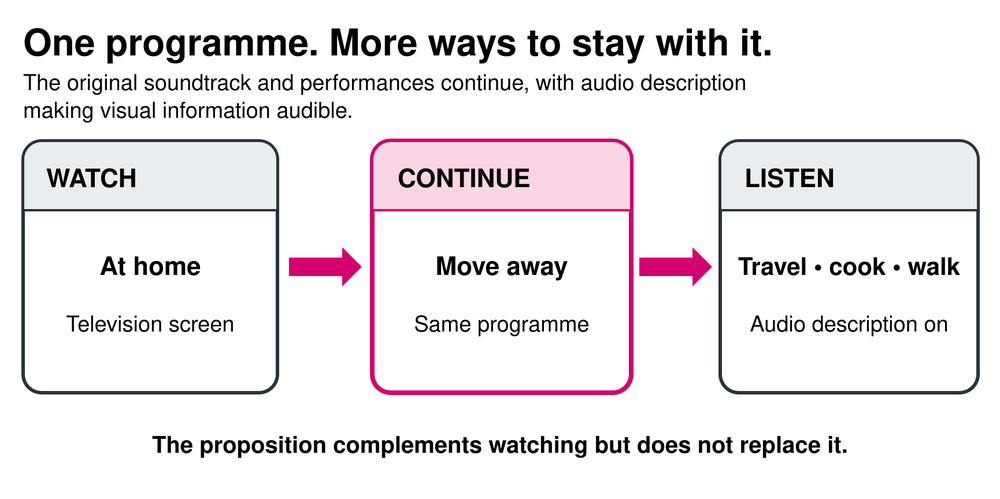
RNIB’s Audio is King project sets out to test whether the original soundtrack, performances, music and effects combined with audio description could work as an audio-first form of entertainment. The aim is not to turn television into an audiobook, or to replace watching. It is to understand whether a programme could continue when the pictures could not.
In this article, “described drama” refers to a television drama presented in an audio-only format, combining the programme’s original soundtrack including dialogue, music and sound effects with audio description.
Why the idea is plausible
Listening is already part of everyday routines. In a nationally representative Ipsos survey for RNIB, 65 per cent of UK adults aged 18 to 65 say they enjoy entertainment that focuses on audio. Nearly three quarters, 73 per cent, agree that audio entertainment is a good way to entertain themselves when they cannot look at a screen, and 72 per cent enjoy it while doing something else.
Audio description itself is less fully understood. The survey finds that 34 per cent have experienced it, while 43 per cent have heard of it but never experienced it and 23 per cent have never heard of it. Our later interviews suggest a further gap: even people who recognise the term rarely consider audio description as something they might choose for themselves.
Awareness of an accessibility feature is not the same as recognising when it might be useful. As one interview participant puts it: “Once I considered it as audio-only content, it began to feel relevant to me.”
Putting the proposition to the test
The research took place in three stages. Ipsos surveyed a representative sample of 1,202 UK adults aged 18 to 65 in March 2026. Participants were randomly allocated two of six audio described clips from drama programmes, each lasting between 60 and 90 seconds. They answered questions about recall, experience and cognition, as well as their interest in the wider proposition.
RNIB then carried out in-depth interviews with 15 sighted participants. These explored existing media habits, reactions to two audio described crime drama clips, likely listening situations, barriers to adoption, where such content might be found and what to call it. Finally, five blind and partially sighted people who regularly use audio description joined a focus group. These qualitative stages were not statistically representative; they help explain why, when and under what conditions described drama might be useful.
The online survey used six audio described clips from drama programmes, each lasting between 60 and 90 seconds. Respondents were randomly allocated two clips from the following programmes:
- The Man in the High Castle
- Bosch: Legacy
- Agatha Christie's Marple
- Agatha Christie's Poirot
- Inspector Morse
- Stranger Things
The subsequent interviews with sighted participants used two clips from this set: The Man in the High Castle and Poirot. The focus group with regular audio description users used clips from The Man in the High Castle and Poirot.
These were existing television audio description tracks rather than audio-only versions created specifically for the research.
As the research used short clips rather than full episodes, the findings capture participants’ immediate reactions and do not tell us how attention, comprehension or enjoyment would be sustained across a complete programme.
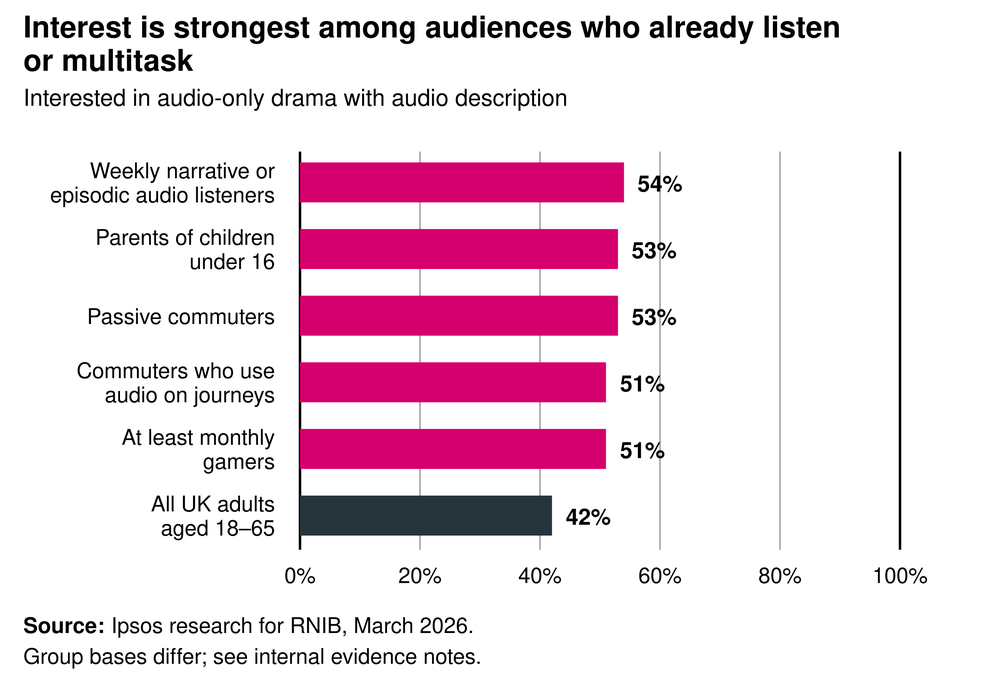
The survey finds that 42 per cent are interested in listening to a drama programme in an audio-only format if it came with audio description. Interest is higher among people who already listen to narrative or episodic audio every week, parents of children under 16, passive commuters (i.e. those who travel to work by bus or train at least monthly), commuters who use audio on their journeys and people who play games at least monthly. See figure 2.
This is a meaningful potential audience, but not necessarily a universal one. Just over half of respondents, 53 per cent, are not interested. The interviews also show different levels of appetite: nine participants are strongly receptive, five see the idea as situational or conditional, and one is personally unlikely to use it regularly. The opportunity is therefore better understood as a set of useful listening moments than as a new default way to consume television.
When the screen cannot be used
Across the research, the clearest value is flexibility. People imagine listening on longer journeys, while commuting, walking, cooking, cleaning, pursuing hobbies or moving around the home. Parents see a role when childcare makes viewing fragmented. Others imagine winding down with a story without adding another screen.
These are not moments when audiences necessarily want a different programme. They may want the programme they have already chosen, in a form that can travel with them. One participant describes the appeal as being able to “take a programme with me, use otherwise mundane time and enjoy more content without dedicating two or three hours to sitting still.”
This also explains why the idea is generally seen as complementary to television. Participants expect to move between watching and listening according to the programme and the situation. They still want to watch when facial expressions, performance, cinematography or spectacle matter. Audio becomes useful when life gets in the way.
The strongest product idea may therefore be less about choosing between watching and listening, and more about continuity: start watching at home, continue listening on a journey and return to the screen later.
What happens when people listen
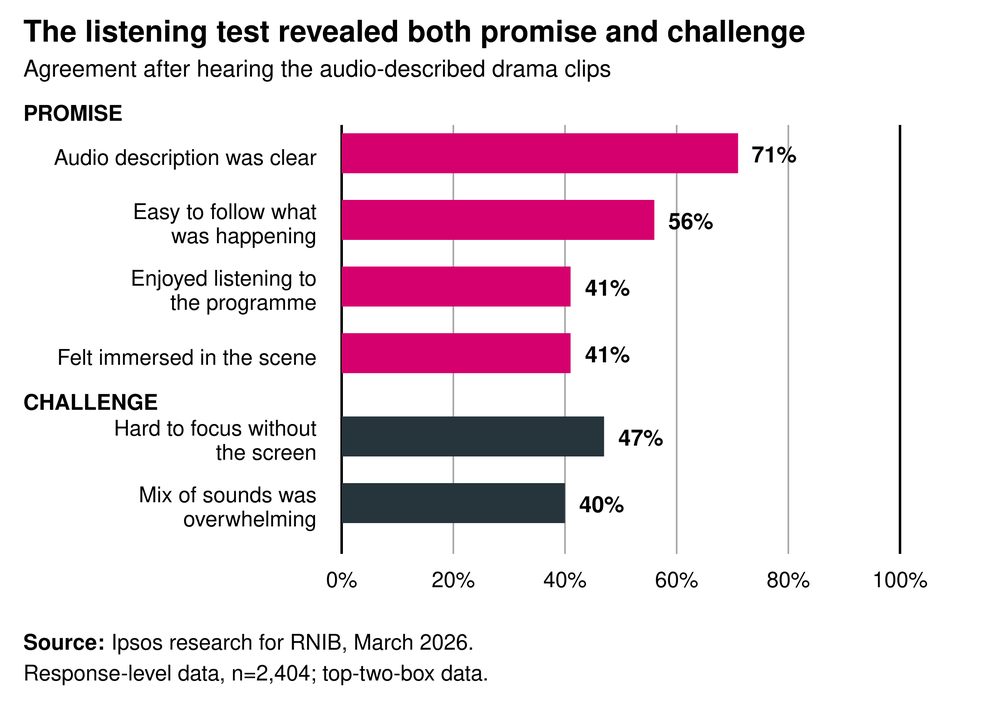
The short clips show both the promise and the limits of using television soundtracks in this way. Across the survey responses to the clips, 71 per cent agree that the audio description is clear and when prompted, around two thirds correctly recall at least two of four moments. 56 per cent find the clips easy to follow.
Enjoyment and immersion are more modest: 41 per cent say they enjoy listening to the programme and the same proportion feel immersed in the scene. Nearly half, 47 per cent, find it difficult to focus without seeing the programme on screen, while 40 per cent find the combination of dialogue, description, music and sound effects overwhelming.
The clips were produced as standard television drama with audio description, not as purpose-built audio-only editions. The results therefore do not tell us that the concept either succeeds or fails in full episodic finished form. They expose the production questions that a real pilot needs to address.
Quality is the gateway
Sighted participants judge what they hear as entertainment. They pay attention to the writing, the narrator’s performance, the amount and timing of description, and the relationship between dialogue, music, effects and narration. If the experience feels crowded, flat or disconnected from the programme, they can simply return to watching or choose another form of audio.
There is no single preferred descriptive style. Nine of the 15 interview participants prefer the shorter, more selective of the two clips; three prefer the richer scene setting of the other, and three have no clear preference. Because the clips were always played in the same order, and some people already knew the programmes or characters, this comparison should not be treated as a controlled test.
The broader principle is more consistent: description should provide the right information at the right moment. Most want enough orientation to understand the people, action and setting, but also enough space to process the information and hear the programme’s atmosphere. Some value concise description; others want more vivid scene-building. Genre, pace and the complexity of an individual scene are likely to affect that balance.
The narrator also needs to suit the programme while remaining clearly distinguishable from its characters. In the survey, 79 per cent want the description to match the programme’s pace, 70 per cent its intensity and mood, and 68 per cent its vocabulary.
Above all, the audio needs to feel coherent. Dialogue must remain intelligible, music and effects must retain atmosphere without competing, and audio description must be audible without sounding pasted on top. When the focus group was asked whether the programme and audio description should feel immersive and coherent, the response was unanimous. One participant captured it simply: “That is what you want: it should feel like one track.”
Keeping blind and partially sighted audiences at the centre
The focus group broadly recognises the same quality principles as the sighted interview participants: suitable pacing, useful detail, a voice that fits the programme and a mix that has been properly checked. But the consequences of poor quality are not the same.
A sighted listener can look back at the screen or switch formats. A blind or partially sighted viewer may have no equivalent way to access the visual information. Wider appeal cannot therefore be pursued by removing detail that the primary audience needs, obscuring the term audio description or reshaping the service around sighted preferences alone.
The experienced users also add important context. They note that people accustomed to audio description may tolerate mixing conventions that new listeners find distracting. They support wider promotion and easy-to-use audio-only distribution, while insisting that quality should not be compromised. They also describe possible direct benefits, including easier downloads, lower data and storage use.
This suggests a useful direction for the next steps in the project: co-design an additional pilot with blind and partially sighted users, and test whether changes intended to improve the audio-only experience also improve the core accessibility service.
From research question to real-world pilot
The research does not establish a new mass-market category. The survey, interviews and focus group used two crime drama clips. We do not yet know how attention, comprehension and enjoyment hold up across a full episode, repeated use or different genres.
It does, however, give us a credible reason to test those questions. A staged pilot could begin with existing high-quality audio description, optimise the mix for headphones and audio-only listening, and make full episodes available on platforms where audiences already watch and listen. It could examine a continue-listening mode on broadcaster streaming services, as well as distribution through audio platforms used for podcasts and audiobooks.
The pilot should test contrasting genres and different approaches to description, voice and mixing. It should also test how the content is labelled. Our interviews find no clear preferred name for the format: some people value the familiar clarity of “audio description”, while others assume the term means the feature is not for them. Clear dual labelling may offer a way forward, pairing a consumer-facing listening proposition with an explicit acknowledgement that it uses audio description.
Most importantly, success should be measured through real behaviour: whether people start and finish programmes, return to the format, switch between watching and listening, and find value in it over time alongside its impact on blind and partially sighted audiences.
Audio description already makes television possible without seeing every image. Audio is King asks whether excellent audio description could also allow more people to keep a programme with them when they stop looking at the screen. The work so far cannot answer this definitively. It does, however, demonstrate the potential and make the case for a full trial.
Interviews from the Audio is King event
At the Audio is King event, RNIB Connect Radio producer Toby Davey spoke to speakers and guests about the research, what it could mean for audio description and where the idea might go next. Listen to the interviews here.
Acknowledgements
We would like to thank Prime Video, ITV and Netflix for supporting this research by providing the audio described programme clips used as testing material in the survey, interviews and focus group.
Their contribution does not imply endorsement of the findings, conclusions and recommendations.
If you have any questions or would like to discuss the research, please contact us at [email protected]
Quantitative study: technical note
This study was carried out by Ipsos on behalf of RNIB. Ipsos conducted a 15-minute online survey of a representative sample of 1,202 participants aged 18-65 in the UK. Fieldwork took place 2 - 9 March 2026.
Within the sample, quotas were set on age within gender, region, and working status – to be nationally representative of the general population. All sample data was weighted to nationally represent in terms of age within gender, region, education and working status.
Within the survey was an embedded audio stimuli test and respondents were randomly allocated to hear two out of six audio clips of drama programmes, each clip lasting 60-90 seconds. Allocation to audio clips had soft nationally representative quotas set on gender and age. The six audio clips were from ‘Miss Marple’, ‘Poirot’, ‘Inspector Morse’, ‘Bosch Legacy’, ‘Stranger Things’ and ‘Man in the High Castle’.
Respondents were asked a series of questions about their recall, experience and cognition about the audio clips they heard. For all data about the audio clips, data is reported on a response level. To measure recall, respondents were asked about four specific moments in the first 60 seconds of the audio clip, two moments being true and two moments being incorrect. Recall is defined as correctly identifying at least two of four.
Qualitative study: technical note
The qualitative follow-up study was carried out by RNIB to build on the findings from the quantitative research. The purpose of this was to explore how sighted audiences responded to described drama in more depth, including what made the experience engaging, difficult, useful or less appealing.
RNIB conducted 60-minute qualitative interviews with 15 sighted UK adults. Participants were recruited by Acumen and selected to include a mix of listening habits, levels of interest in described drama, and everyday listening contexts, including people who listen to podcasts or audiobooks, commuters, parents, gamers or second-screeners, and people who listen while doing other activities.
Participants listened to short audio described drama clips and were asked about their immediate reactions, comprehension, enjoyment, immersion, cognitive effort, likely use cases, barriers and views on the quality of the audio description.
The qualitative findings are not statistically representative and should not be read as a measure of audience size. They are intended to provide richer insight into the reasons behind audience responses and to help identify what would need to be improved or tested further.
Blind and partially sighted focus group: technical note
RNIB also held a focus group with blind and partially sighted participants to ensure the research remained grounded in the core purpose of audio description as an access service.
The focus group explored participants’ views on described drama, audio description quality, narrator style, sound mix, pacing, and the potential risks and benefits of promoting audio description to wider audiences. Participants were asked to reflect on what should be protected, what could be improved, and how wider audience interest could support rather than dilute the needs of blind and partially sighted audiences.
These findings should be understood as qualitative insight rather than representative data. They provide important context on how the opportunity identified in the wider audience research can be pursued in a way that strengthens audio description for its primary audience.
Supporting research materials
This article brings together the findings from the Ipsos quantitative research and RNIB’s subsequent qualitative interviews and focus group. The full Ipsos quantitative research presentation is available below.
Ipsos quantitative research presentation
This deck presents the findings from the Ipsos quantitative study, including the survey results from UK adults and the audio clip testing.