




Blind voices shape community display at Kelvin Hall
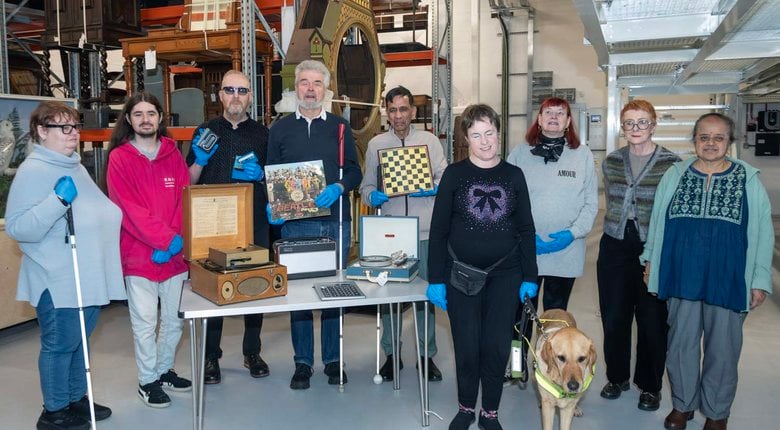
The community curators in the Glasgow Life museum's archive with their selected objects.
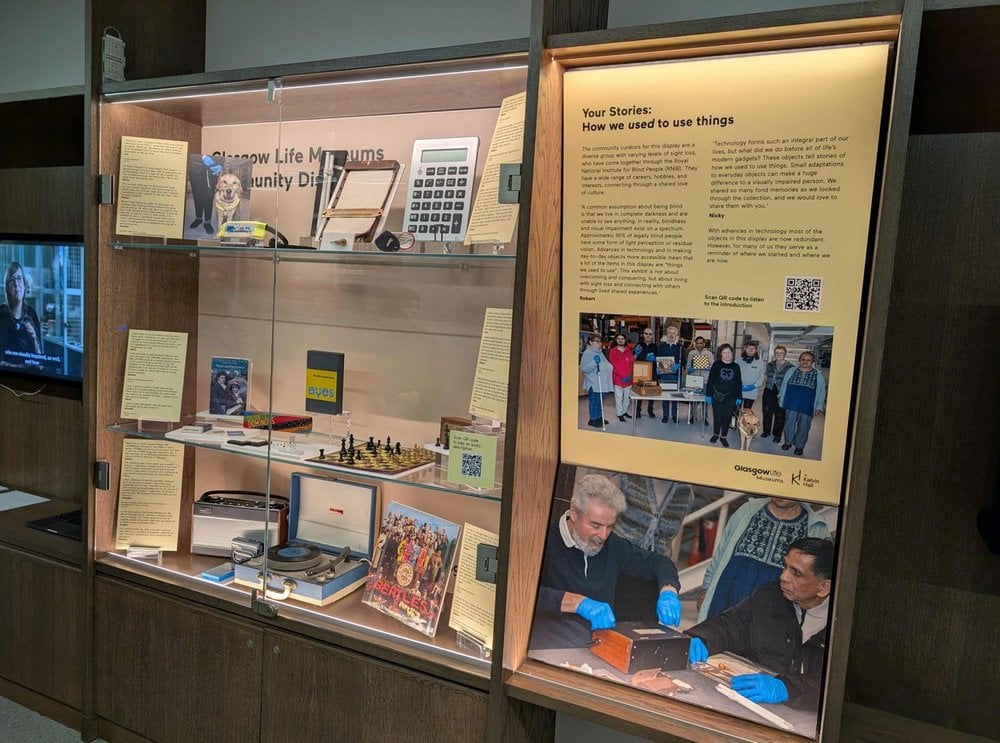
A community display created by blind and partially sighted people launched today at Kelvin Hall in Glasgow.
‘Your Stories’ brings together objects from Glasgow Life Museum’s collection with personal stories from community curators. Participants selected items that resonated with them and shaped the final display by sharing their own experiences, memories and perspectives alongside the objects.
Community members from RNIB Scotland came together over a series of sessions to explore how blind and partially sighted people used objects historically, from record players and audiobooks to games such as chess and dominoes. The display also features objects such as a white cane, guide dog lead, talking calculator, and a braille board with stencil and braille skewer, highlighting the diverse ways people have interacted with and adapted objects over time.
Robert King, a participant in the project, said:
“The objects I chose reflect how I’ve lived with sight loss over time. In the 1970s, I had a portable record player that I could take to friends’ houses, and later a cassette player that connected me to music and audiobooks when I started to find it difficult to read print. They’re ordinary objects, but they show how we adapt, connect and live full lives.”
Among the display are also items more typically associated with the blind and partially sighted community, such as canes and magnifiers.
“The symbol cane was my first piece of ‘tech’ for the visually impaired,” Robert said. “I wasn’t quite ready for a white cane, but I had enough sight loss that I needed something to alert people to the fact that I was visually impaired.
“Working with a group of people who each had their own sight loss journeys was incredibly meaningful. We were sharing experiences, learning from each other, and shaping a collective voice that genuinely represents our community. This exhibit is not about overcoming and conquering but about living with sight loss and connecting with others.”
The display also highlights how accessibility can be integrated into exhibitions. Alongside text labels, visitors can listen to recorded stories created by participants via an audio booth, access information in braille, and scan QR codes to receive content digitally on their own devices.
Kelvin Hall welcomes around 600,000 visitors each year, providing an opportunity for a wide audience to explore the histories and experiences of blind and partially sighted people through this unique, community-led display.
Jane Rowlands, Head of Glasgow Life Museums & Collections, said: “The thoughtful selection of objects chosen by all of the participants involved in this special project expresses so much about the personal experiences of blind and partially sighted people in our communities. The ‘Your Stories’ display will enable visitors to feel connected to their stories, encouraging them to consider and better understand the everyday challenges of those who are visually impaired.
“We hope this unique display at Kelvin Hall also helps visitors appreciate that the items in the city’s museum collections are not just museum pieces; they reflect our social history and the experiences of people in our communities, embodying their character, spirit and resilience.
“Our sincere thanks go to RNIB Scotland for working with our teams in Glasgow Life on this important project, and to everyone involved in developing the ‘Your Stories’ display over the last six months.”
The ‘Your Stories: How We Used to Use Things’ display is open to the public until August 2026.