





MPs visit RNIB’s mock polling station
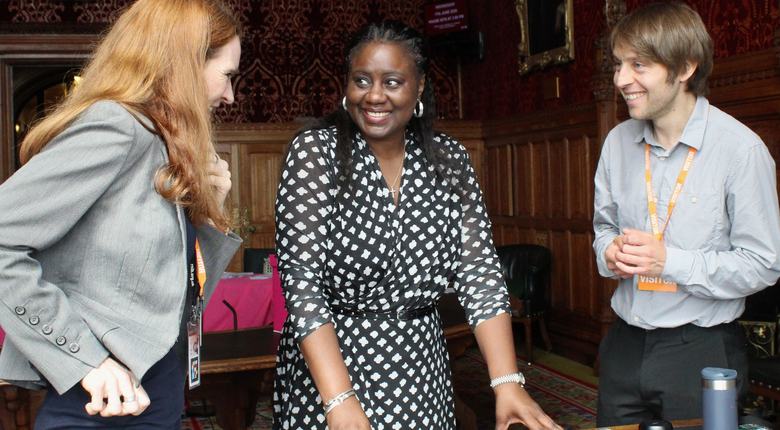
On Wednesday 17 June, MPs and their staff joined RNIB in Parliament to learn how audio-tactile voting devices could enable blind and partially sighted people to vote independently and in secret.
Transforming one of Parliament’s grand committee rooms into a mock polling station, RNIB provided parliamentarians with the opportunity to experience first-hand the barriers many blind and partially sighted voters continue to face when casting their ballot.
The event was sponsored by Julie Minns, MP for Carlisle, who is leading efforts to secure support for her proposed amendment to the Representation of the People Bill which is currently going through Parliament. The amendment, named New Clause 48, would introduce minimum accessibility standards for voting, requiring all polling stations to provide both tactile and audio equipment for voters. At present it is left to each local authority and Returning Officer to determine what adjustments and equipment it will provide.
MPs were invited to wear SimSpecs, which can give an indication of the effects of certain sight conditions, before taking part in a mock vote using audio and tactile voting devices, including the McGonagle Reader. The device enables blind and partially sighted people to navigate the ballot paper and access candidate information independently through a combination of touch and audio guidance.
After casting their vote, participants placed their ballot papers into one of RNIB's bright pink ballot boxes, completing the full polling station experience.
A democratic right denied for over 150 years
RNIB Head of Policy, Mike Wordingham, said: “The event highlighted the fact that there is currently no legal requirement for polling stations to provide audio-tactile voting devices. As a result, many blind and partially sighted people are still unable to vote independently and in secret, despite the secret ballot being a cornerstone of British democracy since the Ballot Act 1872. Amending this bill is an opportunity to change this, ensuring every polling station provides what is needed, rather than the current situation which places the burden on blind voters to find out what equipment is needed, request it, and still not be confident that their request will be met. “
Evidence gathered through an RNIB trial, delivered in partnership with the Ministry of Housing, Communities and Local Government and the Electoral Commission, shows that audio-tactile voting solutions significantly improve both voter independence and ballot secrecy. A combined audio-tactile device (a tactile template with an integrated audio player) achieved a 93 per cent success rate for correctly cast votes.
Research from the 2024 General Election, also found that every surveyed voter who used a combined audio-tactile device reported an improved voting experience, with 85 per cent saying it was "a lot better."
Building support for change
Among those attending this pop-up event were Marsha de Cordova MP, Chair of the All-Party Parliamentary Group for Eye Health and Visual Impairment; Lisa Smart MP, Liberal Democrat Spokesperson for the Cabinet Office; and RNIB Champion, Lee Pitcher, MP for Doncaster East and the Isle of Axholme.
Reflecting afterwards, Lee Pitcher MP said:
"The interactive mock polling station provided me with an opportunity to experience first-hand the barriers that many blind and partially sighted people continue to face when voting at polling stations, and to discover how access to audio and tactile voting devices can help deliver an independent and secret ballot.
"There are always opportunities to improve and adapt systems, and with new technology developments all the time, my job is to make sure we continue to create legislation that allows for it all to be used. I'm committed to doing that for every blind and partially sighted person."
What’s next?
RNIB’s Public Affairs team will now build on the conversations and connections made during the event to build further support for this amendment.

